
I have written a few articles on careers and player age. It is a topic which fascinates me.
In this article I want to compare the early development of forwards and defensemen. Specifically, I will look at the myth that defensemen need more time in the minors to become reasonable NHL players.
When This Article Was Written
This article was started in February 2026, while I was in the sunny Dominican Republic. It was then massively re-written in April 2026, on a snowy day.
The original version of this article was large and rambling. On reviewing it, I thought that more than half of the article addressed material I had already published. I got out the shovel and the mucking boots and removed more than half of the original article.
Statistic of Measurement: Productivity Rating (PR-Score)
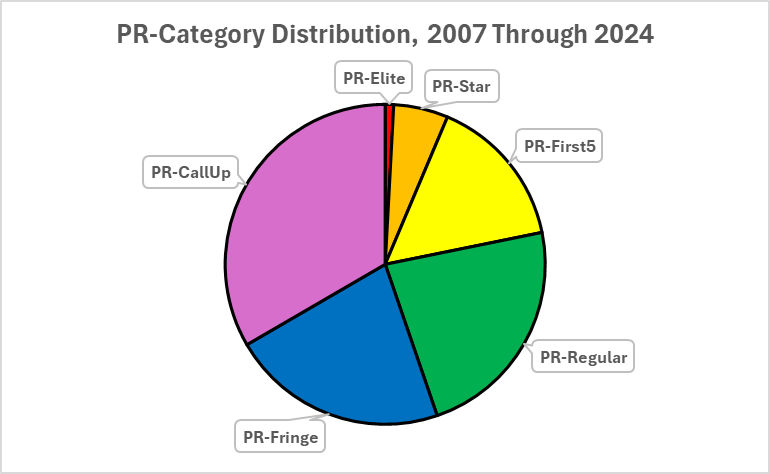
The statistic used to rate players at the beginning of their careers is PR-Score. A quick aside for those who don’t want to read the related PR article: PR-Score is a number that rates a player’s season on an open-ended scale with a normal range of zero to ten. PR-Scores place players in one of six PR-Categories. The PR-CallUp category is for players with PR-Scores between 0.00 and 1.99; PR-Fringe is for players with PR-Scores between 2.00 and 3.99. PR-Elite seasons are for PR-Scores above 10.00. The chart below, the first pie chart I have ever used, shows the distribution of PR-Categories between 2007-08 and 2024-25.
Career Starts – Qualifying Players
A player’s career starts in the season he plays his first game in the NHL. To ensure that a player’s first appearance in the Stapled To The Bench (STTB) database is also his first possible NHL appearance, I’ll only use players born in or after 1989. The first season for which there is freely available detailed data for players is the 2007-2008 season, and an eighteen-year-old player that season (Sam Gagner, e.g.) would have been born in 1989.
To ensure that any player who has started his career has had at least three seasons he could have played, the 2022-23 season is the latest season from which a player can qualify.
In total, players have two criteria to qualify for career-starting analysis: they have to have been born after 1988, and their first season can be no later than 2022-23.
Career Starts – Measuring Players
The “measurement” of a player’s career start is the sum of his PR-Scores from his first three seasons. That statistic will be called F3PR-Score. The pertinent data for two youngsters is in the table below.

When a player doesn’t play in one of his first three seasons his PR-Score for that season will be zero.
Career Starts – Categorizing Players
The top category for the start of a career, F3A, is for player’s whose F3PR-Score is at least 18.0000. That value is what a player would amass with three consecutive seasons with the lowest PR-Score that qualifies for a PR-First5 categorization: 6.0000. Both MacKinnon and Ekblad are F3A players, even though both of them had one season that was PR-Regular (MacKinnon’s second season, Ekblad’s third).
A PR-Score between 4.0000 and 5.9999 is a PR-Regular season. Three times the lowest part of that range is 12.0000, so players whose F3PR-Score is between 12.0000 and 17.9999 will be in the F3B category.
All remaining players will be in the F3C category. There won’t be anything more about players who start their careers as F3C players, and this is reasonable as most players who start their career as F3C players do very little in the NHL.
Career Start Age by Position
The following table has data about the start of player careers by age and position. D and F are the counts of defensemen and forwards who started their careers at a specific age; D% is the percent of those players who are defensemen; D Ave F3PR is the average F3-PRScore of the defensemen; F Ave F3PR is the average F3-PRScore of the forwards.
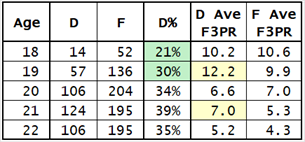
A team generally dresses six defensemen and twelve forwards, meaning 33% of the skaters on a team are defensemen. This provides context for the D% column. If players were not being delayed at the start of their careers, D% would be close to 33% for all ages.
The green-shaded cells show that the start of careers for defensemen are being delayed. Teenage defensemen are under-represented.
The final two columns can help us evaluate whether the delay is merited. Those cells contain the average F3PR-Score of the players who started their careers at a certain age, with yellow-shaded cells highlighting cells that are at least 1.0000 greater than the other position. From these data, I infer that the young defensemen who play in the NHL are generally better than the forwards in their age groups.
General managers are cautious with teenage defensemen, who face a steeper trust barrier. As a result, the teenage defensemen who do make NHL lineups tend to be stronger players than their forward counterparts. In effect, teams apply a higher standard to young blueliners.
This next table gives more information about the strength of young players. For each age and type of player (D=defenseman, F=Forward) you can see the number of players that played, the number that were F3A and the number that were F3B. The last datum for a position is the percentage of players who were F3A or F3B.
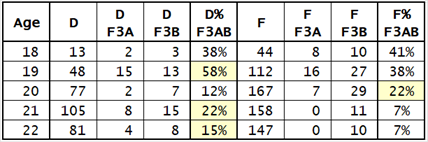
The cells that are shaded yellow are those whose value is at least 7% higher than the value of the other position. 58% of age-19 defensemen were F3A or F3B; only 38% of forwards were F3A or F3B.
Evaluating the Myth About the Development of Defensemen
To restate the myth, defensemen are assumed to require more time in the minors in order to play effectively in the NHL.
The data supports the myth in so far as it shows that defensemen, generally, are given more time in the minors. Players who start their careers at the ages of 18 and 19 are disproportionately forwards.
The data implies that the myth may be a slightly bad idea. The average F3PR-Score of a defenseman who started his career as a teenager is 11.8, while the average F3PR-Score of a similarly aged forward is 10.1.
When I talked to the son (my household hockey expert) about this, he thought that general managers might be protecting their young defensemen. His thoughts were that young defensemen are weak defensively, and since a defenseman’s weak defensive play will end up in the local press coverage, a young defenseman’s confidence could take a significant hit if he costs the team a couple of games.
The same pressure would not be placed on forwards; it seems to be accepted that a young forward can’t play defense.
Without boring you with two pages of technical stuff, I did confirm that young players are weak defensive players, both defensemen and forwards.
Summary
I expected to see that the younger a player plays well, the better his future is. This proved to be true. A good start doesn’t always lead to a good career, but it usually does. A weak start doesn’t always lead to a short career, but it usually does.
I was not particularly surprised that defensemen start their careers as teenagers less frequently than do forwards. It is a maxim that defensemen have to learn to play defensively in order to be effective in the NHL. The data implies that General Managers are reluctant to play teenage defensemen, so only the very best teenage defensemen get a shot in the NHL. Teenage defensemen are likely not better than teenage forwards. What is happening is their numbers are “filtered” by the decisions taken by general managers.
Related Articles