
Welcome to the fourth Stapled to the Bench (STTB) regular season awards article. The Awards have matured since the first effort. Humorous award names are gone, with one exception, and unusual categories are also gone, with the same exception.
This year I decided that I wanted to recognize old-time players with award names, focusing on but not limited to the 1920s Ottawa Senators. As always, award winners are selected solely due to statistics.
Cy Denneny Most Valuable Player Award
The MVP Award goes to the player with the highest Value Rating (VR) in 2025-26. VR evaluates a player’s performance over the last three regular seasons.
Connor McDavid had been MVP since the 2018-19 season but was overtaken this season by Nathan MacKinnon.

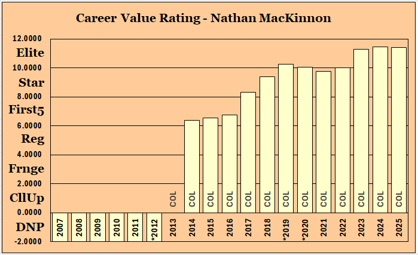
The VR-Scores of the top three players all end in zero due to rounding to two decimal places. Rounding to four decimal places, their VR-Scores were 11.3989, 11.0969 and 11.0966.
I usually only publish rating scores with one or two decimal places so that readers don’t confuse numeric precision with accurate evaluations. While VR and PR are obviously accurate, in that the best players have the highest ratings, I do not believe that they are accurate to four decimal places. It’s best to assume that McDavid and Makar are basically of equal and extremely high value.
Joe Malone Best Forward Award
The Best Forward Award goes to the forward who has the highest Productivity Rating (PR) in 2025-26. PR evaluates a player’s performance over the regular season.
The Best Forward in 2025-26 was Connor McDavid.

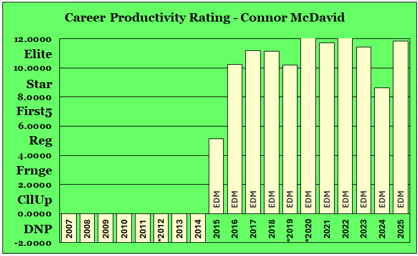
As you can see from the PR-Scores of the three leaders, McDavid was the best forward last year by a good margin. His drop to second place in VR-Score (behind MacKinnon) was largely caused by his 2024-25 season, in which he missed sixteen games. Let me compare McDavid and MacKinnon in other statistical areas.
My most recent Future Value Rating process shows that MacKinnon should be the slightly better player in 2026-27 while McDavid should be slightly better in 2027-28.
If I were in a points pool for 2026-27, I’d pick McDavid before MacKinnon, but I’d pick Celebrini over both of them.
When it comes to PR-Scores, McDavid has had the two best seasons ever (2020, 2022) and also had the tenth best season (2025). MacKinnon has had the third best season ever (2023). McDavid has clearly had the better career.
Buck Boucher Best Defenseman Award
The Best Defenseman Award goes to the defenseman who has the highest PR-Score in 2025-26, which was Evan Bouchard.
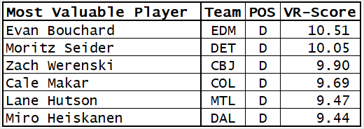
I felt that six defensemen deserved some recognition for their 2025-26 play.
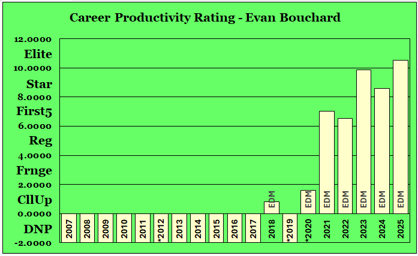
Whether Bouchard is super-talented or super-fortunate is a fair question. He is fortunate in that he gets to play with McDavid and Draisaitl, which obviously improves his statistics.
xGW% is the winning percentage of a player at 5v5 based on expected goal data. It is a measure of how well a player plays. The better players are above 50%. For the season Bouchard’s xGW% was 59%: he’s a good player.
Bouchard was most frequently paired with Mattias Ekholm. When they were together, Bouchard’s xGW% was 62%; when not playing with Ekholm, his xGW% was 54%. He played better with a better defensive partner.
When Bouchard was on the ice with McDavid or Hyman or Draisaitl, his xGW% was 68% (frequently Bouchard was on the ice with all three at the same time). He played better when paired with the better forwards.
Hockey is a team sport: it is impossible for hockey statistics to solely measure an individual player’s performance. All players, from McDavid to Ryan Reaves, benefit when playing with excellent players and suffer when playing with fourth-liners.
Clint Benedict Best Goalie Award
The Best Goalie Award is determined by Goalie Expected Points (GxPts). GxPts is calculated from a goalie’s expected goals against, his actual goals against and the time he played. GxPts estimates the standing points an average team would get based on a goalie’s statistics.
The winner is Logan Thompson, with 77.0 GxPts.
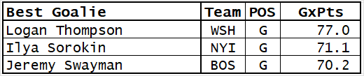
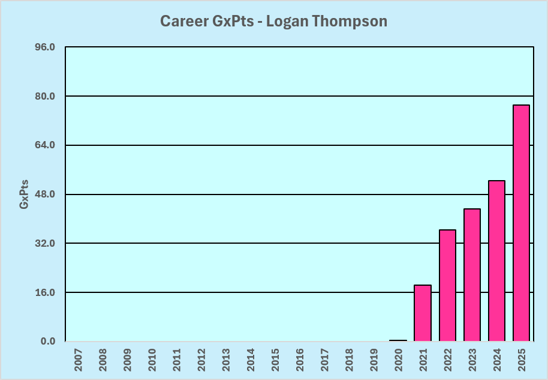
Thompson is early in his career and is doing very well. In case it isn’t obvious, he won’t continue to have annual GxPts increases as he has had so far. GxPts has a practical limit.
Could he get to 87.0 GxPts next season? Logically, it is possible. With the current way that Number 1 goalies are used, it is nearly impossible. He’d have to play as well as he did last season AND ALSO play 4,000 minutes, about nine more full games.
Since 2007-08, 40 goalies have played at least 4,000 minutes in a season. Since 2017-18, only one goalie has played at least 4,000 minutes: Carey Price, 2019-20, 4,029 minutes. But Price didn’t have a Price-like season that year: his GxPts was 60.5.
Only one goalie has come close to 87.0 GxPts since 2007-08, and that was Henrik Lundqvist (NYR, 88.4 GxPts in 2009-10 and 86.7 GxPts in 2012-13).
Not only is Thompson unlikely to log as many as 4,000 minutes, he is also unlikely to play as well as he did in 2025-26. He gave up 140 goals but his expected goals against was 188.23, meaning he gave up 48.23 goals fewer than expected. His saves-above-average per 60 minutes (SvAA60) was 0.84, which is the best value for any goalie since 2007-08.
It is most likely that his 2026-27 season will see a drop in performance. That would be due to “regression to the mean,” where extreme results are usually followed by more ordinary ones.
Punch Broadbent Best Rookie Award
The Best Rookie Award goes to the Rookie who had the highest Productivity Rating (PR) in 2025-26. As NaturalStatTrick.com does not identify rookies, I used Evolving-Hockey.com to get a list. I cannot vouch for the completeness of its list, but it was a far better list than any I could come up with.
The winner is Matthew Schaefer. His PR-Score of 8.96 was just more than 1.00 PR-Points higher than Lane Hutson’s Rookie of the Year winning PR-Score last year, and more than 3.00 PR-Points better than runner-up Beckett Sennecke.
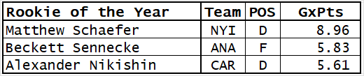
Since 2007-08, 78 players have played in the NHL at the tender age of 18. Only ten of those players had a PR-Score that put them in the PR-First5 or better categories. Nine of those players were PR-First5. Schaefer is the only player who was a PR-Star in his age-18 season.
The next two-best 18-year-old seasons came from Aaron Ekblad (2014-15, PR-Score 7.31) and Nathan MacKinnon (2013-14, PR-Score 7.16).
Auston Matthews was 19 years old in his first season, where he earned a PR-Score of 8.12. While it was a PR-Star season (PR-Scores of 8.0000 to 9.9999), it was in the bottom of the PR-Star category. Schaefer’s season was in the middle of the PR-Star category.
Schaefer’s rookie season was unique in two aspects. It was the best rookie season (regardless of a rookie’s age) ever and the best age-18 season ever.
Frank Nighbor Best Defensive Forward Award
The Best Defensive Forward Award is given to the forward who had the highest total PR-Points from six statistics that have a defensive flavour: penalty-kill time on ice, blocks, take-aways, hits, defensive-zone-balanced-expected-goals-against and defensive-zone starts. The winner is Michael McCarron with 1.75 PR-Pts from the defensive categories. The gap in PR-Points between first and second is the same as the gap second and twelfth.
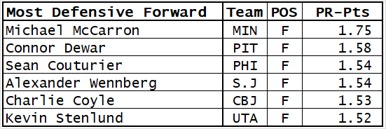
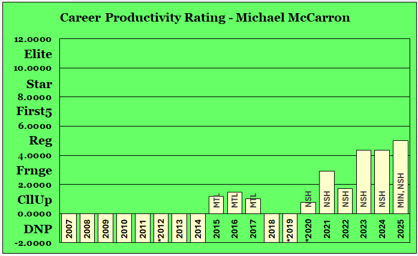
It may seem strange to give a season award to a PR-Regular player. McCarron’s PR-Score is low because all he does is play defensively.
The most complicated component of PR-Score is based on expected goals against and defensive zone starts. It compares a players xGA against an estimate that is determined by time-on-ice and defensive zone starts. Nick Suzuki, the winner of the Selke award for a defensive forward, had 31% of his 5v5 faceoffs in the defensive zone (a below average figure); based on his ice time (at 2.515 xG per 60 minutes) he should have 50.44 expected goals against; he had 54.04 expected goals against. He had a below average defensive responsibility AND showed below average defensive capability.
McCarron had 44% of his 5v5 faceoffs in the defensive zone; at 3.100 xG per 60 minutes he should have had 46.07 expected goals against; he had 36.03 expected goals against.
Just at 5v5 play, McCarron saved his team 10 goals. Suzuki cost his team 3½ goals. The Selke award decision in 2025-26 was an embarrassment for its voters.
Milton Waddams Stapled to the Bench Award
This award is named after Milton Waddams, a character from the movie Office Space who loved his Red Swingline stapler. If the award had a physical presence, it would obviously be a Red Swingline stapler (the Swingline 747 in Rio Red).
The Stapler goes to the player who spent the most time stapled to the bench. Bench time for a player is calculated by 60 minutes per game played minus his time-on-ice. While the “stapled to the bench minutes” includes time spent in the penalty box, it does not include time spent in the press box.
The winner is Brandon Duhaime (WSH, F). Duhaime played all 82 games and was on the ice for 907.6 minutes. 60 minutes times 82 games is 4,920 minutes, and subtracting 907.6 minutes from that gives 4,012.4 minutes.

The players who spend the most time stapled to the bench tend to dominate in one statistical area: hits delivered per 60 minutes of ice time (H60).
The top twelve bench-riders have an average H60 of 13½. The league average H60 for forwards who played at least 1,230 minutes (15 minutes per game) was less than 3.
Are there a lot of big-hit guys in the league. I created a definition for a bruiser as a player who played at least 820 minutes in the season and who had an H60 of at least 10. There were only 27 bruisers in 2025-26.
Vegas, a Stanley Cup Finalist, had three bruisers (Keegan Kolesar, Jeremy Lauzon and Cole Smith). Carolina, a Stanley Cup champion, had zero bruisers. Their leading H60 players were Jordan Staal and Andrei Svechnikov.
In my personal and non-statistical opinion, the value of a bruise to his team is highest in the playoffs. The advantage of hitting is it can wear down one’s opponents. In the regular season, you wear a team down in one game and, in the next game, that worn down team plays another team. In the playoffs, your team gets to play that worn down team.
I haven’t done a study (yet), but I expect most bruisers would have a higher average TOI in the playoffs than in the regular season.
Summary
I could have given an award to Macklin Celebrini for being the best young player (under 23), but I didn’t. Heck, he could have won the award for being the best teenager!
I could have given an award to Ryan O’Reilly for being the best old player (over 33).
In years gone past I would have given an award to Artemi Panarin for being involved with the fewest total hits per 60 minutes, but I now recognize that I was a silly category. Total hits is the sum of a player’s hits given and hits taken, by the way.
Keifer Sherwood would have won the award for most total hits per 60 minutes, but that’s just the opposite end of that silly category.
I could have given an award to Dylan Larkin for being the best center, based on a classical understanding of what a center should do. Morgan Geekie could have won an award for being the best shooter in the league. Juraj Slafkovsky could have been given an award for being the best sixth man.
This article could have been sixteen printed pages long, but it isn’t.
Reference Articles