
A few years ago, Stapled To The Bench (STTB) created the Regular Season Hall of Fame (RSHOF), a Hall whose membership was determined by regular season play. It didn’t matter how well a player played in the playoffs, it didn’t matter how well a player played internationally, it didn’t matter whether the player has a heart-warming back story. If a player had the regular season numbers, into the RSHOF he went.
I have redesigned the RSHOF evaluation process. This article explains the new process and introduces the inductees.
When This Article Was Written
This article was started in August 2026, and endless twiddling around with the text led to it being finished in September 2026.
Who Should be Inducted into the RSHOF?
Simply stated, the RSHOF should be for players who were among the best in the league for a considerable length of time. Very simply stated.
A more structured way to consider RSHOF membership comes from the Phaneuf List, which is based on baseball statistician Bill James’s Keltner List in The Politics of Glory: How Baseball’s Hall of Fame Really Works. The Keltner List had many questions which put a framework on a player’s accomplishments. I reworked the list so that it worked for hockey, and named it after Dion Phaneuf because, at the time, there was a discussion as to whether Phaneuf should be in the NHL Hall of Fame.
The Phaneuf List has five questions, all of which can be answered based on statistics.
The Phaneuf List
- Was he ever regarded as the best player in hockey, or the best player at his position?
This is obviously a very high bar: very few players have ever been considered as being the best player in hockey. The statistic I’ll use in relation to this question is MaxV, a player’s maximum Value Rating (VR-Score).
- How many MVP-type seasons did he have?
A player could be considered as having an MVP-type season if his Productivity Rating score was in the PR-Elite category (or if his Value Rating score was in the VR-Elite category). The counts of those seasons for a player are stored in variables called PRE and VRE, respectively.
- How many All Star-type seasons did he have?
This was answered by counting the number of PR-Star and VR-Star seasons a player has had. The counts are stored in variables called PRS and VRS, respectively. I also counted the number of times a player’s PR-Score put him in the top 40 players in the league (variable name T40P), in the top twelve forwards (T12F) and in the top eight defencemen (T08D).
- How many good seasons did he have when he was past his prime?
The focus for this item is on length of career rather than peak performances within a career. I wanted to credit players who played past their prime at an effective level, so I counted seasons where a player was at least 29 years old AND had a rating of PR-First5 or better. Corey Perry has had twelve seasons where he was at least 29, but only three of those seasons (when he was aged 29, 30 and 31) saw him rated PR-First5 or better.
The count is stored in a variable called OG (Old and Good).
- How many effective seasons did he have?
I counted the number of seasons a player had a PR-Score that placed him in the PR-First5 category or higher (PF5P).
How Did Phaneuf Do With Respect to the Phaneuf List?
His maximum VR-Score is 9.54. He had one PR-Elite season (PRE=1), four PR-Star seasons (PRS=4), seven VR-Star seasons (VRS=7) and four OG seasons (OG=4). He was in the top 40 players four times (T40P=4) and the top eight defensemen twice (T08D=2). He had eleven seasons that were rated PR-First5 or better (PF5P=11).
Are those the numbers of a Hall-of-Famer? To answer that question, we need to compare his counts to those of all the other players. Is Phaneuf near the top of all players?
I devised a formula that would convert the various statistical counts into a single number called RSHOFScore. An examination of the RSHOFScore of all players led to the establishment of a cutoff value for RSHOF induction. If a player’s RSHOFScore is above the cutoff value, he will be inducted into the RSHOF.
I’m now going to talk about how RSHOFScore is calculated, and that’s going to take two printed pages in the PDF version of this article. If you want to skip to the chase, go to the RSHOF Inductees section. When you then see your favourite player hasn’t been inducted, you can return to this point and read about the logic that was used.
RSHOF Formula, Generally
Each RSHOF statistic will be raised to an exponent and then multiplied by a category weight to determine a number of RSHOFPoints.

The exponent (PlyrExp) is based on a player’s PF5P value. It is 1.00 plus one-twentieth PF5P: a player with five PF5P seasons will have a PlyrExp of 1.25. The more PF5P seasons a player has had the bigger his PlyrExp value will be, which will increase RSHOFPoints.
Let’s say a player has a category count of three (it doesn’t matter which category it is for this example). The table below shows how RSHOFPoints would increase as PF5P increases.
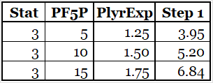
PlyrExp increases the reward in all categories for players who have had a long and effective career. Both John Tavares and Mitchell Marner have been in the top twelve forwards (T12F) four times, but Tavares gets more RSHOFPoints for that because his PF5P count is higher (17 for Tavares, 10 for Marner).
StatWeight (SW) is used to make some statistics matter more than others. For example, PRE and VRE (Elite seasons) are worth more than PRS and VRS (Star seasons). The next table shows what happens to the Step 1 values with different StatWeights (SW).
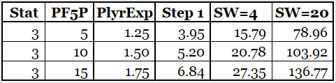
RSHOF Formula: Example
It is time for a specific example, using the data of an anonymous player. I’d like you to consider his statistics without knowing his name, to remove recognition bias. Also found in the following table are the weights for each category.
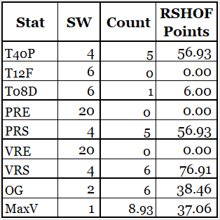
This defenseman began his NHL career in 2010-11 and he played last season. He has had 13 seasons where he was PR-First5 or better (PF5P is not shown in the table above), so his player exponent is 1.65. His RSHOFScore, which is the sum of RSHOFPoints, is 272 (rounded to a whole number).
Let’s consider his data while thinking of the Phaneuf List questions.
He was in the top 40 players five times, but only once was he among the very best at his position (T08D); he was never an elite player (PRE and VRE are zero); he had five PR-Star seasons and six VR-Star seasons; he had six Old and Good seasons and his maximum VR-Score was 8.93, which is in the middle of the VR-Star category.
Does that sound like a Hall of Fame career? It doesn’t to me. To steal a line from a host on the afternoon show on TSN 1200 radio, it sounds like a Hall of Pretty Good career.
The defenseman in this example is Ryan McDonough (D, T.B).
RSHOF – The Line in the Sand
I needed to establish an RSHOFScore above which a player is inducted into the RSHOF. The line in the sand was drawn at 400.
Admittedly that is an arbitrary place to draw the line, but it is a nice round number and it produced an appropriate number of RSHOF inductees (34). A lower criterion would have players like Jay Bouwmeester in the RSHOF, while a higher criterion would exclude players like Ryan Getzlaf.
In the coming seasons I expect membership to grow by about three players per season on average. There is no limit to the number of players that can be inducted after a season: if ten players qualified, they would all go in. There is also no minimum number of players who must be inducted. If nobody new qualifies after a season, nobody is inducted.
With an RSHOFScore of 272, Ryan McDonough has not yet done enough to qualify for the Regular Season Hall of Fame.
RSHOF Sends its Regrets to Pavel Datsyuk
Pavel Datsyuk does not qualify for the RSHOF, due to an unfortunate lack of data.
Datsyuk’s career began in 2001-02. His first five NHL seasons happened before the NHL started publishing the detailed statistics which STTB uses to evaluate players. Assuming that three of those earlier seasons were PR-Star level seasons, he would easily have qualified for the RSHOF.
This is also true for: Mario Lemieux, Mark Messier, Guy Lafleur, Bobby Hull, Gordie Howe, Maurice Richard and Howie Morenz.
RSHOF Sends its Regrets to P.K. Subban
If you were an NHL fan in the period from 2010 to 2017, you would be very familiar with P.K. Subban. He was lightning fast, he delivered highlight-reel hits and he scored. The first nine seasons of his career overlap with John Carlson, another high-level defenseman. The Career Productivity Rating Charts for both players for that time period are below.
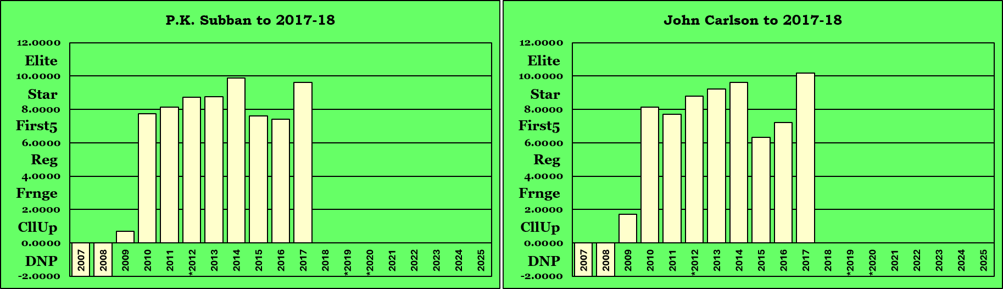
It is hard to imagine two careers being so similar across nine seasons. Their total PR-Scores for those seasons are Carlson 68.9, Subban 68.6.
Their careers went in different directions starting in 2018-19. The data implies that an injury impacted Subban’s ability to play. He missed 19 games in 2018-19, and he never again achieved the level of play he had had up to 2017-18.
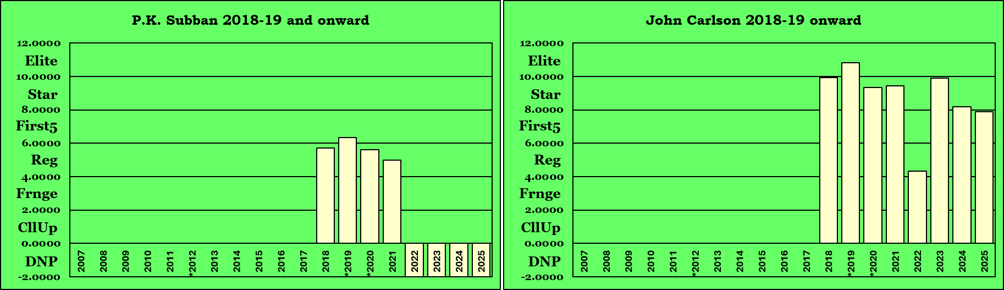
P.K. Subban fell short of induction into the RSHOF due to the end of his career: it was far too brief and far too average. His final RSHOFScore was 196.
Carslon earned his induction to the RSHOF after the 2020-21 season. His current RSHOFScore is 1,217. For the purposes of being inducted to the RSHOF, it does not matter in the least that his RSHOFScore continues to grow.
RSHOF Inductees in Order of Induction
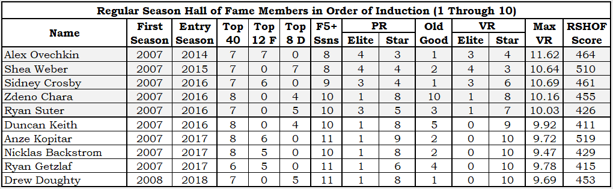
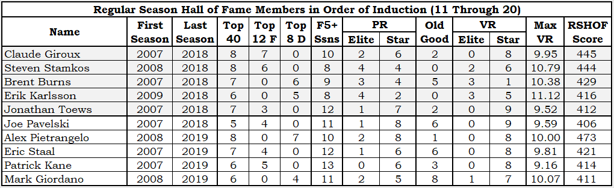
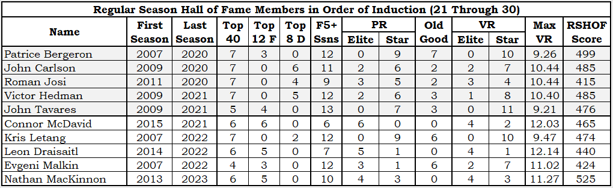

The data shown in the tables above reflects a players statistics the season they were inducted. RSHOFScore will increase as a player continues to play well: Ovechkin, Crosby and Kopitar all have RSHOFScores above 2,000 as of last season.
RSHOF: Length of Time to be Induction
Connor McDavid is the only player who earned induction after seven seasons of play. He was injured in his first season and then followed it up with six consecutive PR-Elite seasons.
Auston Matthews and Alex Ovechkin were inducted after eight seasons of play. Ovechkin is one of those players whose RSHOFScore doesn’t fully reflect is career, as his first two seasons were played before detailed, publicly available statistics existed. He scored 98 goals in those two seasons: he might well have qualified in seven seasons if those two seasons could have been used.
Shea Weber and Leon Draisaitl each took nine years to be inducted.
Sidney Crosby took ten years to be inducted: as with Ovechkin, his chase for the RSHOF began in 2007-08, as his first two seasons were in the “pre-detailed-statistics” era. Also, Crosby had serious injuries in 2010-11 and 2011-12 which delayed his chase. With detailed statistics he would easily have qualified in eight seasons. Without injuries, he might well have qualified in seven seasons.
Kris Letang and Evgeni Malkin both took sixteen years. Their careers have featured significant peaks of performance and significant periods of injuries.
RSHOF: Active Players Who Are Close to Induction
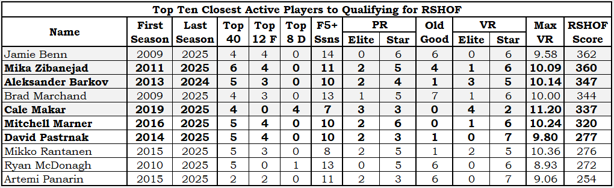
The five players presented in bold in the table above (Zibanehad, Barkov, Makar, Marner and Pastrnak) are very likely to be indicted to the RSHOF. The other five (Benn, Marchand, Rantanen, McDonagh and Panarin) are unlikely to qualify, given the number of seasons they probably have left and their current level of play.
Panarin is the most likely player from that second group who could earn a spot in the RSHOF. If he could squeak out a PR-Star season next year and then have a PR-First5 season, he’d need one more PR-First5 season to get his RSHOFScore above 400. It’s not entirely impossible for him, as he is still playing well. But he is about to turn 35, and sooner or later Father Time will come calling and his productivity will drop.
Summary
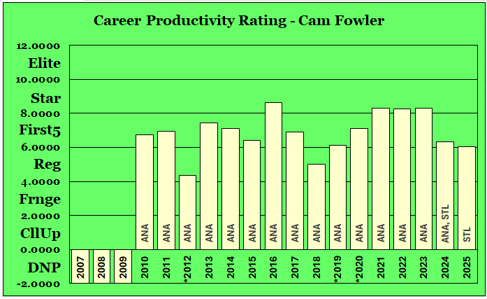
Cam Fowler has been around for a while and has had some good seasons but is not the in the RSHOF. He does not qualify for induction for a completely different reason than P.K. Subban: he has had little significant peak performance. Subban didn’t qualify because his career lacked prolonged effective performance, something Mr. Fowler has in Spades.
Dion Phaneuf has a RSHOFScore of 238, good enough for the Regular Season Hall of Pretty Good. There are 86 members in the RSHOPG (RSHOFScore of at least 100).
Related Articles